Zati for construction contractors
The handoff is where project work stalls
Most construction delays are not technical failures. They are handoffs that quietly break: a revision arrives and nobody owns the response, a submittal sits unreviewed, a question reaches the wrong trade and dies in an inbox. Zati gives you a workspace where AI workers can be configured to hold defined parts of that handoff, while the decision stays with your project manager.
Start from the moment work stops moving
Pick a real project and a real week. Look at what was outstanding, what was late, and what never got assigned. That list is usually the honest starting point, and it is usually shorter than people expect.
From there, the question is not what AI should do. It is which part of the coordination you would trust a prepared worker to own, and which part must stay with the person who carries the schedule and the contract.
Build the team around three assignments
A starting configuration for a general or specialty contractor could run like this.
- A project controls worker takes the supplied RFI log, submittal register and authorized correspondence, and returns an item list where every entry keeps its source reference and recorded date.
- A field coordination worker takes supplied meeting notes, drawing references and trade updates, and returns a revision-conflict list: where two documents disagree, what each one says, and which question needs answering.
- A commercial preparation worker takes approved correspondence and your team's review checklist, and returns a packet of unresolved commercial questions for management, each with the evidence attached.
Every assignment names an owner, the inputs it may use, the expected output and the reviewer who accepts it. Workers get names, instructions, skills and a reporting line, so the work reads as a team rather than a queue of prompts.
Inspect the work before it moves
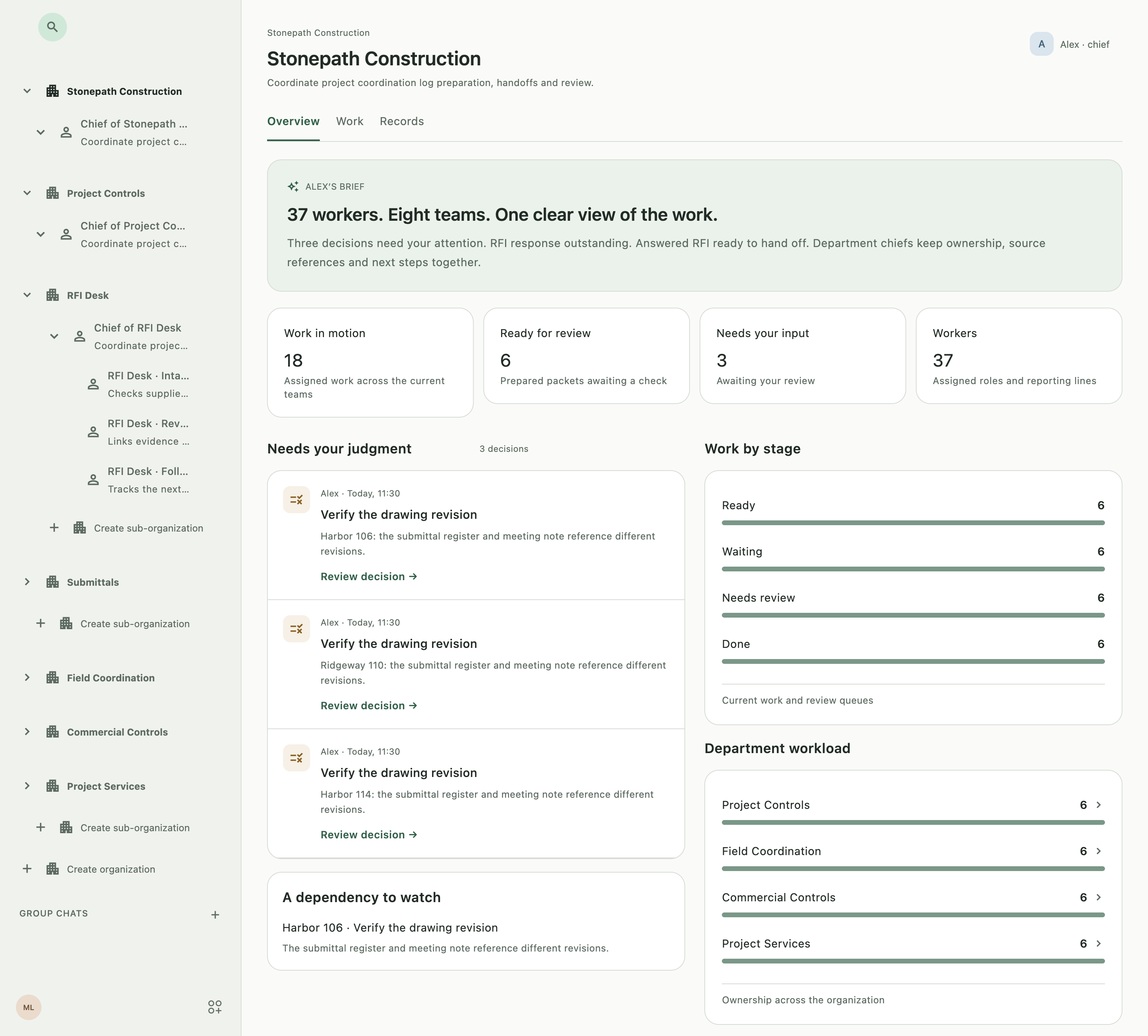
Open any assignment and you can see the inputs, the produced artifact, the verification result and the open questions. Work advances through review rather than on its own. A worker can propose a follow-up to a subcontractor, but the draft waits in a review queue until your project manager approves it.
That distinction matters more in construction than in most fields. A brief that says an item was overdue is a reading of a recorded date. A brief that says a notice period was missed is a contractual conclusion, and it needs a qualified professional who knows the contract and the project history. Configure the assignment to produce the first, and keep the second with your people.
Assigned work, review queues and next steps. Open the image for a full-size view.
Set the limits, keep the authority
Give each worker a project scope, a spending allowance and a defined set of sources. Decide what needs review, who signs off, and what should stop the work and come back to you. Your project management and accounting systems keep their records and rules; supplied logs set the starting point, and any additional access depends on supported connections and permissions we verify with you.
The AGC/Sage 2026 outlook found 45% of 951 respondents reporting office and administrative AI use, with 61% using it or planning more. Treat that as a direction of travel, not a benchmark. Your question is whether this specific handoff is worth the attention it currently takes your project manager.
Grow from one project to a structure
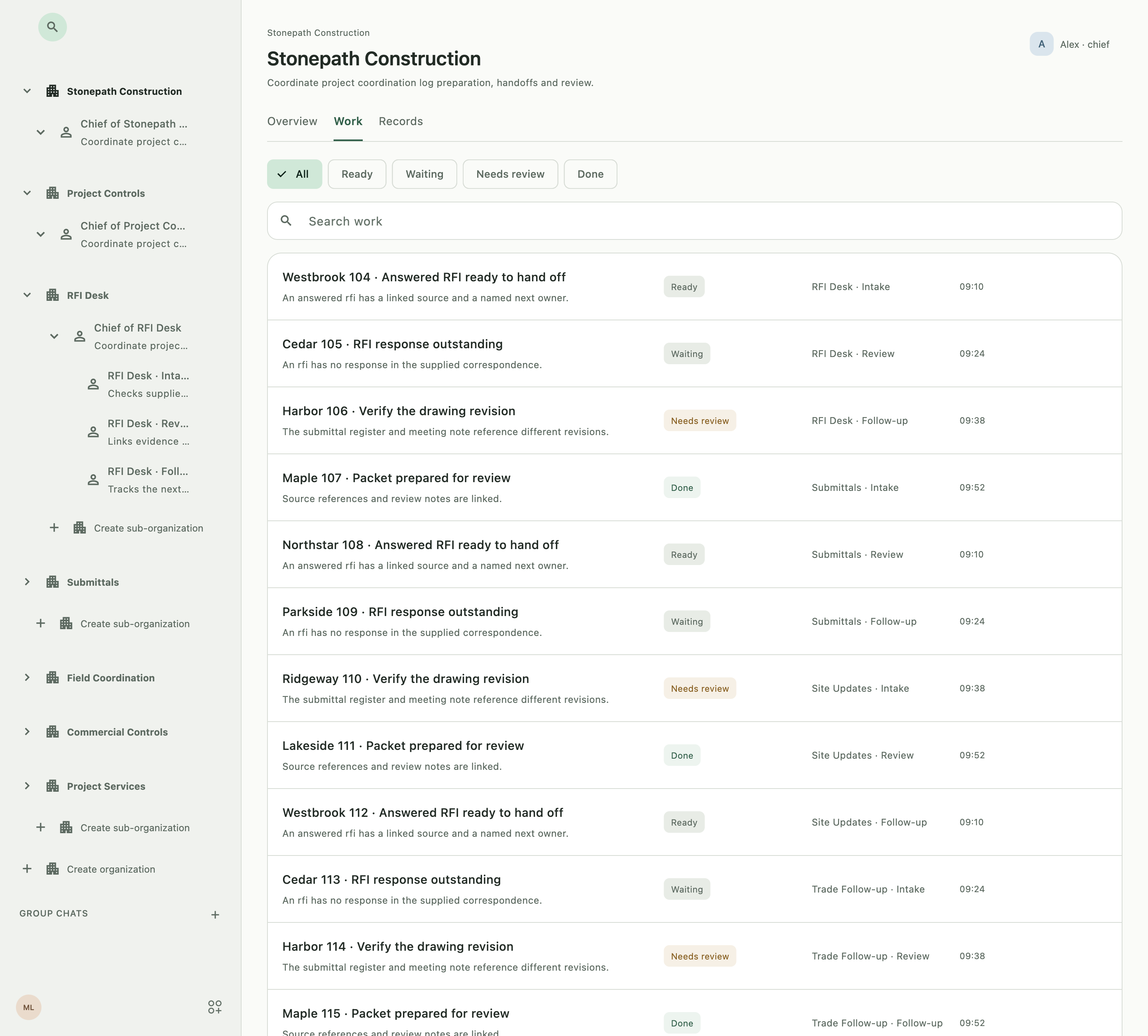
Once the first configuration works, the same pattern can extend: a project-services lead coordinating the specialists, separate conversations per project, recurring schedules with missed-occurrence handling, and reporting on unresolved work and decisions. You decide how much structure the work justifies.
Organizations, teams and workers in one workspace. Open the image for a full-size view.
Questions before you start
What if our logs are messy?
That is normal, and it is part of what the call covers. We look at the exports you actually produce and agree what a usable source reference looks like before anything is configured.
Who decides if an item is truly overdue?
Your project manager and qualified professionals. Workers prepare the item, cite the source and flag the uncertainty; the contractual call stays with your team.
How much does this cost to run?
We scope the workers, inputs and review cadence on the discovery call, then agree what the first configuration should be. No pricing is assumed before that conversation.
Bring one stalled handoff
Pick the project where work kept getting stuck and show us the logs. We will map the assignments, the review steps and the decisions that stay with you.